Showing posts with label bread. Show all posts

Thursday, September 11, 2014

Baking in a Baking-House and The 3-Week Plan: Day 11

The small house on the far right is the baking house. 
All this talk of and drinking boiled coffee made me remember when a friend of mine bought a house and moved out in the country. On the property was a bagarstuga, a baking house. Way back, building a baking oven was quite an expensive investment, and in many villages here in the north, they would build a joint one, where the women would bake together, sometimes for days at a time. Mostly, they would bake tunnbröd (thin bread), which was dry - much like a biscuit - and could be stored for a long time, and mjukkaka (soft cake) which was a flat, soft bread.

Today mjukkaka is commerically baked by Polarbröd bakery in Älvsbyn, and their brandname, polarkaka (= polar cake, or bread), has to a large extent replaced the old name mjukkaka (I have seen recipes for "how to bake your own polarkaka"). This bread is exported all over and we once had a very expensive sandwich in Paris, salmon on polarkaka!

Anyway, my friend invited a group of us to bake in her bagarstuga, and I think I had a cold or something (it is more than 15 years ago, and hard to remember exactly), because instead of baking, I was taking photos. My friend´s husband was heating the oven with birchwood, and when it was hot enough, the embers were raked to the far side and the bread was placed on the hot brick surface. On the side of the oven was an open fireplace where he boiled our coffee. Of course, we had some fresh bread with it!

It was a great experience and when the mum-in-law tells her stories of baking the old way, I know exactly what she means. My friend and her husband have since given up this house and moved back to a flat in town, but they had some great years in the country, doing all the things they had dreamed of: raising sheep and ducks (I have some photos of myself picking feathers from dead birds, but for some reason they tend to gross people out...), had a garden (she even wrote a chapter in a garden book, about gardening in the severe northern climate), and what not. But I suppose everything runs its course eventually - they seem very happy back in town.

About my 3-week plan: I am eating alone tonight and since I can´t bother cooking for myself alone, I am having tea and sandwiches for dinner. It´s a bit lazy, but that´s ok, too.


Tuesday, September 2, 2014

The 3-week Plan: Day 1

I spent a big chunk of Saturday night watching baker Paul Hollywood making one bread after another (6 episodes in one sitting). Bread is my big biggest weakness in life, even more than cookies (which is a kind of bread anyway) and I was quite inspired to break out of my rut.

I was starting fresh with a new 3-week planning period anyhow, and due to some unforeseen dinner parties and restaurant visits, I was shuffling dishes around a bit. I decided to do a chicken sallad type thing on Monday, with freshly baked rosemary bread and tapenade.

I made the bread the day before, using cold water, kneeding it well and shaping it in a kind of bun cake, storing it in the fridge over night. Hollywood apparently always use cold water for all his breads and let them rise for hours, and his method made me remember having done one of these cold water recipes before, so I kind of winged it. The next morning, I just took the buns out, heated the oven and popped them in for forty minutes. It came out a very nice-looking loaf.

I had also made tapenade the day before (with the Bosch blender, which is a gorgeous little helper, much better than mum-in-law´s Braun, which tends to splash the food onto the walls) from a tin of black olives that I found in the pantry, capers, garlic, olive oil, lemon juice, ground black pepper, and anchovy. There should have been fresh basil in it, but I forgot.

The recipe I (kind of) followed called for "sardeller" and at first I couldn´t find it in the store, so I picked up a small jar of anchovy. Then I did find "sardeller", only to find, when I got home, that they are made with sulphites. The anchovy had ättika (which I can find no other translation for than vinegar, but it´s not made from wine, it´s a mixture of acetum and water) in it, so I decided to go with that. Now I find that the translation of "sardeller" is anchovy, and I am rather confused as to what the difference really is. Wikipedia seems to think it´s pretty much the same, except "sardeller" is pickled with oil and salt, and anchovy with vinegar. Hm, that´s not entirely corresponding with what it says on the tin. Oh well. I used anchovy and saved my "sardeller" for some future buffet party where I can avoid eating it myself. After I had made the tapenade I realized that capers has white wine vinegar in them as well. It is very annoying, and I hope there isn´t enough to trigger my sensitivity...

So, this evening I tossed the chicken with onions, peppers and a couple of cold potatoes in a frying pan (added the forgotten basil leaves before serving and I think they were better used that way), put lettuce and tomatoes on half our plates, and served the bread with tapenade. Yum!

Friday, April 25, 2014

Grandma Lisa´s Loaf

I bake most of my own bread. I am a bread-lover, and what can I say? Once you start, it is really hard to go back to the store-bought stuff. Also, Sweden isn´t exactly known for its bread culture. When my father came to Sweden, he absolutely loathed the Swedish sweet loaf (which this is an excellent example of), and the German colony where he lived rejoiced when they found a bakery (miles and miles away, but closer than Germany) that made something called "German loaf" which was a sour-dough bread, baked in an old stone oven, with a chewy crust that resembled nothing I have tasted since. He bought a special, large freezer and filled it every chance he had. A family of six, we would finish one loaf a day. And I suppose that is why I love this bread so much - I only had it at grandma´s, so the taste, for me, is full of holiday feel and that special grandma love.

As it is, I am a pretty lazy sort of person. Or efficient, as the husband would say. I really don´t have time to spend hours and hours in the kitchen and messing with my hands in dough isn´t my idea of fun (although I know plenty of people who thinks that´s the point of the whole process). So, when I found this wonderful way of baking bread in an article in the Guardian a few years back, I adopted it immediately. I have hardly tasted a store loaf since.

I bake a large loaf on 1 liter of water, which I then divide into four pieces, freezing three for later. I also always use dry yeast, which my mum-in-law slightly frowns at, but really, it´s what you get used to. That´s the thing really, to becoming a prolific baker: get used to one way of doing it that suits you and adapt the recipes to your particular process.

Water temperature is crucial. 45- 50 degrees Celsius, which is a lot warmer than you would use for fresh yeast (and I understand that in many countries fresh yeast isn´t really available everywhere, as it is here). What I do is I take cold water from my tap (10 degrees) and mix with boiling hot water at a ratio of 3-2. So, typically 600 ml of cold + 400 ml of hot. Which makes perfect. In my house. If I use some left-over cream, say, from the fridge, which is at a temperature of 4-5 degrees, I´d mix it 50-50 with boiling water.

For grandma´s recipe, only one type of flour is used, which we call rågsikt. It´s a 50-50 mix of sifted rye and wheat flour that´s typical to Sweden. Of course, you could make your own mix. I put some flour in my bowl, add 2 envelopes/bags (12 g each) of yeast, 3 eggs, 300 ml of brown sugar (that´s one heaped cup), 1 tablespoon of salt, and 1 liter of warm water. I use the dough whisks for the electric mixer, and keep adding flour until it looks a bit like whipped cream. Not liquid, but not as dry as a regular bread dough, either. Cover with a towel and leave to rise for 40 minutes.

When it has risen, pour the whole thing in a roasting pan. I have a nice, large one that´s about 40 x 35 cm (15 x 14 inches), which I line with non-stick oven paper. I powder it with flour, using a teaball, cover it with the towel and leave for 25 minutes, also turning the oven to 200 degrees Celsius (about 400 Fahrenheit). When it has risen some more, I prick the dough and shove it in the oven for 50 minutes. Every oven is special, so one just has to experiment.

It takes a few hours to cool, and you really should let it cool properly before you put a knife to it; it turns into sticky crumbles if you don´t.  Grandma actually used to make buns of this, but it tastes the same whatever shape you make it in.

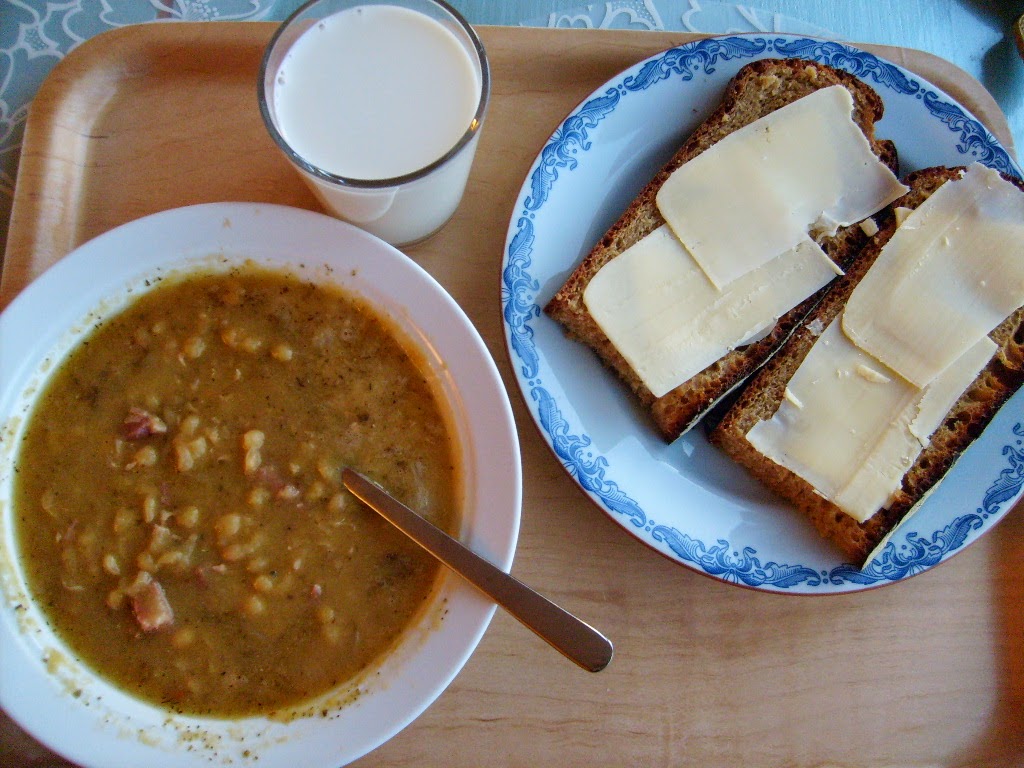
It is excellent with butter and hard cheese, served perhaps with a meat soup of some kind. Or, as I did yesterday, with a yellow peasoup from the freezer. And a glass of milk, of course; because I´m Swedish!