Showing posts with label dinner. Show all posts

Wednesday, March 4, 2015

Fondue - Festive and Lazy at the same time

Start with potatoes, they take the longest.
When I was a child, the traditional meal on Christmas Eve was fondue bourgignon, a meat fondue. It´s a very festive kind of meal, takes a while to eat, and it feels a bit primordial to gather round "the fire", as it were. My siblings and I all still make it, but more or less modified from how my parents made it. For example, my father disliked potatoes, so my mother served rice. The only one who still insists on rice is my middle sister, who is the most conservative of us and maintain family traditions for her little boys. My youngest sister, who moved to Switzerland some years ago, sometime eats it with crisps (chips for Americans), because that´s done there. We have been influenced by having fondue in Paris, and will gladly have potatoes au gratin or chips (French fries for Americans). We usually have it on the 27th, but it´s not a deliberate tradition, it is just that it´s hard to make for more than six people, and it´s a great break from the regular, Swedish Christmas food.

So, this is what we do: We often buy ready-made potatoe wedges (sometimes sold as Pommes Chateau = Palace Potatoes), particularly when I´m all cooked out after the holidays. They just go into a casserole dish and into the oven for 25 minutes. While that bakes, we make a tray with small or wedged onions, fresh mushrooms (champignons), bite-size pepper, and sometimes baby corn. We mix a sauce from mayonnaise and chopped up capers (I use about 100 ml of capers to half a jar of mayo, but use your own judgement) and get out a bottle of barbecue sauce.

We were keen to try my home-pickled onions, but they
 are not a regular constituent of the fondue table.
We heat 750 grams of coconut butter (1½ packet, it´s enough to use one if there are only the two of us) in the fondue pan, on the stove. You know it´s hot enough if you dip a wooden toothpick in it and it bubbles. You can use cooking oil, or stock even, but oil spatters dangerously and stock makes the meat more boiled than fried. Also, the coconut gives the meat a really nice flavour. With the sauces and the salted potatoes I don´t find it necessary to put salt and pepper on every piece of meat, but I know some do. Whatever makes you happy.

Oh yes, almost forgot, we dice up the meat, of course. We use filet of pork and beef, and, if we can find it, horse and reindeer and elk. You can use chicken or turkey as well, but I wouldn´t think fish is particularly suited to this method of cooking. The pieces should be about 2 x 4 centimeters or thereabouts.

We used to use methylated spirits (T-sprit), but now we use a kind that´s special for these kinds of burners - it produces less soot, which makes washing up easier.

Lazy people mix the caper sauce straight in the mayo jar.

Love the blaze! There is reindeer to the left and pork in the forefront. 

It is important to mark all the fondue forks differently, so that each person can recognize their own.

We keep the potatoes warm under a lid - this meal easily take an hour, or more.

Monday, March 2, 2015

A Vegetarian "Steak"

When I left my parents´s house and set up my own home, I knew little to nothing about how to cook. My mother was on the one hand not very amused by cooking, on the other she liked to do it alone - she is neat and tidy and don´t like messes. As a teenager I was very clumsy - as many teenagers are - and I got pretty much grounded from the kitchen area after a series of catastrophes. At least, this is how I remember it.

My first cookbook was this one, published by Cranks, a vegetarian restaurant business in the UK, which opened its first restaurant on the legendary Carnaby Street in 1961, when London was swinging. There are no original Cranks restaurants left and I never got there; I planned to go with my brother when we were in London in 1988, but he fell ill that day, and just as well - the original Cranks that I knew from the cookbooks was already gone by then (but I didn´t know, because there was no internet). I think I would have been very disappointed.

The recipes are all vegetarian, wholefood, and very British. This suited me, who was a strict vegetarian (lakto-ovo) between the age of 17 and 23, when I started eating fish. By 26 I was back on meat, though I will never be a lover of bloody steaks and this recent fashion for raw meat is not to my taste at all. I still love vegetarian food and will eat it out if it is on offer, but serving a meal without even a small sausage for the husband makes him look somewhat forlorn and I do want to please him. However, I have decided to make those old favourite dishes again, after having whipped out the recipe for "nut-steak" (really, I don´t know the name of it in the original English, so this will be a case of translating back to English, which is always a bit hazardous) for a vegetarian guest over Christmas. This is a dish that works well to substitute meat on a regular buffet; we had potatoes au gratin and sallads that everyone could eat. I have actually served it to people who thought they were eating meat! (This makes me suspect that many people eat with their eyes rather than with their noses and palates.)

You need 225 grams of mixed nuts (I like hazelnuts, walnuts, cashews, almonds), 1 onion, 100 grams of breadcrumbs, 300 ml vegetable stock, a dollop of butter, and spices (I stick to salt and pepper, but go crazy if you like). The recipe also calls for 2 teaspoons of brewer´s yeast, which I skip, but then I like to add a can of sliced mushrooms instead.

Grind the nuts in an almond grinder. Fry the choped onion and the mushrooms in the butter. Put all the ingredients in a bowl and mix with the stock to the consistency you´d like to have if you were making a meatloaf (which is what this will look most like). Put the mixture in an oven proof casserole dish, sprinkle breadcrumbs over it and shove it into an oven heated to 200 degrees Celsius for 30 minutes, until golden brown. You can fry it hamburger shaped also, if you like, but that´s more work and not as healthy.

It´s great with a brown gravy, or onion rings (perhaps stewed in cream), potatoes of any kind, or cumberland sauce. It works on bread too, with a beetroot salad. Also, it freezes well. Anyway you like, really.

"Nut steak" with mash and fried onions. 

Saturday, September 13, 2014

The 3-Week Plan: Day 12 and 13

There isn´t much to say about day 12. I was eating alone and made French Toast for myself, or something resembling French Toast. In England they call it "Eggy Bread" and eat it with ketchup, which doesn´t sound particularly tasty to me (perhaps because I detest ketchup). I am firmly Americanized in regard to French Toast, which is called Fattiga Riddare in Swedish, (= poor knights) and eaten with jam or sugar and cinnamon; I insist on syrup. It doesn´t have to be maple syrup to please me, ordinary Ljus sirap (light syrup, which is actually more golden) is fine. A cousin of French Toast is Bread Pudding, which I also enjoy, but the husband not so much, so I rarely make it. It´s basically jam sandwiches soaked in egg and milk and cooked in the oven. Yum! You may call this dessert, I call it dinner when I feel like it.

And very pretty-looking beans they are!
Day 13 is Saturday and improv day and I decided to have some proper food, even though I was eating alone again. I haven´t been able to get the cornbread out of my mind since Divers&Sundry shared her recipe (which you find in the comments) with me the other day, and I decided to make it and have something suitable to match. I can´t quite get my mind around what catfish is, so I went with black eye peas, or beans, as they are called here. I googled for a nice-looking recipe and found Dave´s Georgia-style soup, stew, or pot or what you want to call it. It is not unlike Swedish yellow pea soup, but that is a lot more creamy than Dave´s seem to be according to his photos.

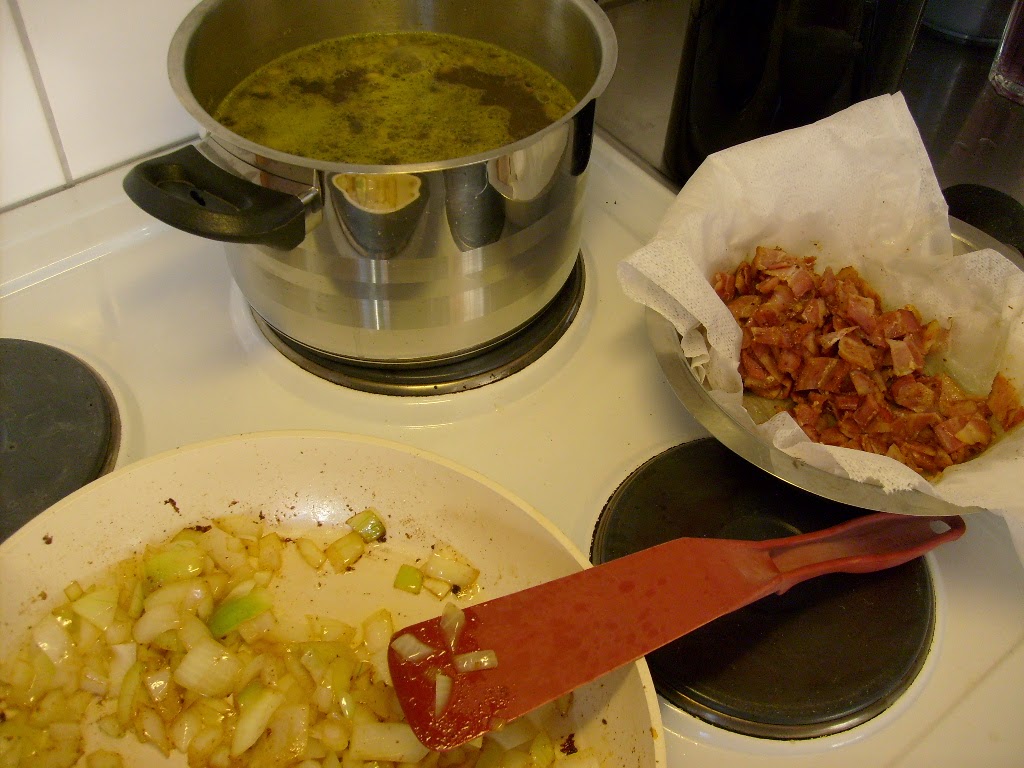
I halved the recipe; the beans come in 900 g bags, which is almost exactly 2 pounds, so I took half that. I let it soak over night, then added 1,5 liters of water, four cubes of vegetable boullion, 2 fried regular size onions, 240 g of fried bacon (they come in 120 g packets), and skipped the ham. I added whole grain white pepper, since it is a slow-cooking thing. No salt, and as it turned out, with the saltiness of the bacon and the boullion, it doesn´t need any.

Dave says to keep this on the stove for 8 hours (!) after soaking, but the reviewers seem to think four was enough. I tried my beans after 3 hours and they were thoroughly cooked, but I wasn´t quite hungry yet then, so I let it sit for another hour, while doing my excercises for the drawing course I am attending. After that, I was both frustrated and hungry!
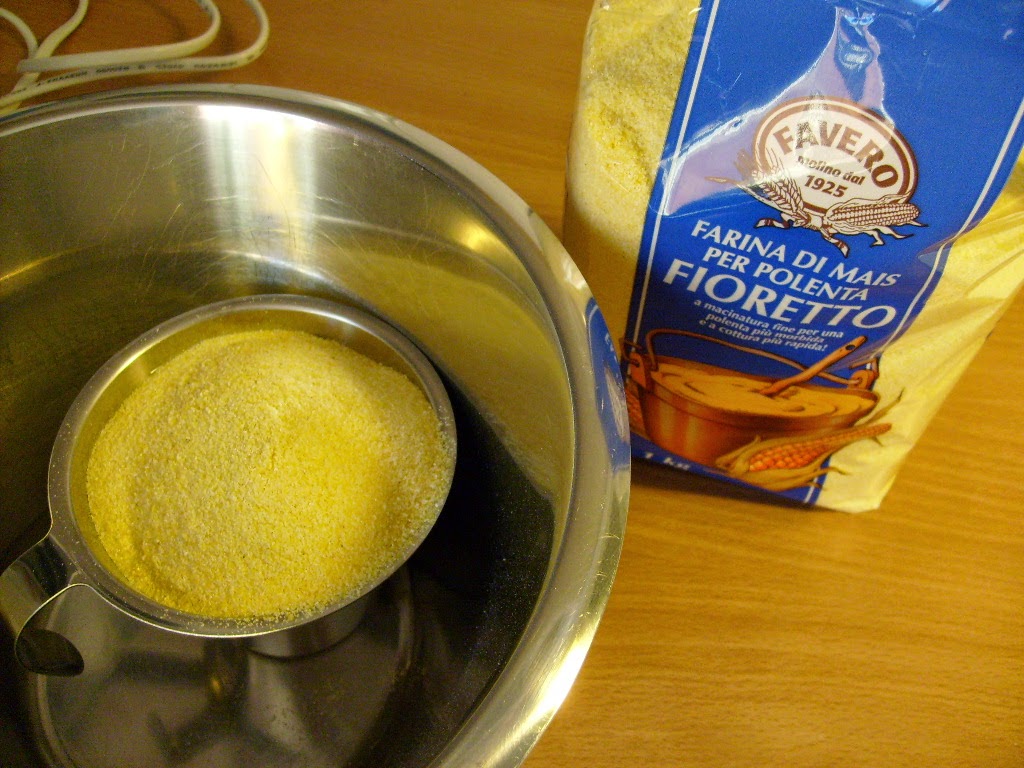


Now, this is important: when Americans speak of corn, they don´t mean korn, which is tempting for a Swede to think. They mean maize (Sw. majs), also called Indian corn, as of corn-on-the-cob (Sw. majskolv). Corn in Britain can mean oats (Sw. havre) or even wheat (Sw. vete). Swedish korn is barley in English, and it´s the stuff they make malt whisky of, while the American bourbon whiskey is at least partly made from corn - I mean maize. Confusing, eh?

The corn (maize) flour I bought comes from Italy and is called farina di mais per polenta. Polenta is a maize porridge, mostly known to Swedes from fancy restaurants where it is left to cool and congeal, cut up, grilled and served with meat. Don´t get the wrong kind, or you will end up with a very boring and sad sponge cake.

I made the cornbread pretty much like I make sponge cake. The trick is to mix the dry ingredients and the wet separately, and then stir just enough to mix it. The mum-in-law taught me to use one of the whisks, it´s a really good trick. It came out very nicely, I think. Perhaps Divers&Sundry will please grade my attempt?

I understand black eye peas are traditional on New Year´s Eve in the southern States, and is considered to bring luck for the new year. Well, I am certainly impressed enough to make this one of my standard recipes and make it for guests as well. We´ll see how it does in the freezer, but I don´t think it matters much if the beans fall apart some.


After having done the dishes, I poured myself a well-deserved G&T and knit some on my scarf while watching Guy Ritchie´s "Sherlock Holmes - A Game of Shadows".


PS. If you are Swedish and reluctant to try American/English (ok, the Brits are officially on the liter scale, but so often prefer "old money") recipes because you can´t get your head around "cups", check out your local ICA or Coop for quarter liter (2,5 dl) measuring cups. They now also come with cup- and half cup measuring lines, as you can see in the picture below. Liters on the right, cups on the left. Thank the good ol´ internet & multiculturalism for that one. DS.


Tuesday, September 9, 2014

The 3-Week Plan: Day 8 and 9

Day 8 in the plan said pickled herring. The husband didn´t feel like it and took me out to a restaurant. We went to one of our regular places, Mediterran, where a pair of brothers from Kosovo (we think) make Italian food, and very well, too. I had Spagetti Bolognese and the husband had Pasta a la Casa, which is fillet of pork with capers and red peppers.

Elder herring and archipelago herring.
We had the pickled herring today instead (the plan said sausages, but they keep in the freezer). I have written about that before, so I will not bore you with a long tale about that. I bought a new kind, Skärgårdssill (= archipelago herring) and it wasn´t perhaps as good as it looked. It was seasoned with herring roe, which made it taste a bit like Kalles Kaviar, another Swedish speciality which is excellent on a hardboiled egg sandwich. I probably will not buy that one again, but stick with our favourites: löksill (onion herring), svartvinbärssill (black currant herring), flädersill (elder herring), citronsill (lemon herring), and senapssill (mustard herring). There are many more flavours out there, this really is a staple in Swedish cooking.

The sugar is kept in an old
lidded beer jug.
Besides the herring, we boiled potatoes, hard-boiled some eggs, added some lettuce, yellow pepper, and grated carrots. Now, the husband likes his carrots coarsley grated with a sprinkling of lemon on top, while I like mine finely grated, with half a tablespoon of sugar on top, disolving in lemon. The sugar doesn´t really make the carrots taste sweet as candy or anything, but rather brings the flavour out in an absolutely wonderful way, like a spoon of sugar does to a tomato sauce. My mother used to make it like this and to me, it´s the only way.

Also, we had some tunnbröd (= thin bread). Our favourite comes from Dahlberg´s home bakery in Piteå. It has an excellent crunch to it and a strong taste of fennel seed.

Friday, September 5, 2014

The 3-Week Plan: Day 5

The plan for Friday said sausage with mash, but I was having more left-overs than I thought, so I decided to fry the roast potatoes & carrots from Tuesday with onions and peppers to make them go further, and serve them with the five last slices of roast beef, accompanied with lettuce, chutney and creme fraiche. The husband prefered barbecue sauce, which isn´t my thing really, can´t get into that smoky stuff. We found some rye crackers and ate them with the last of the tapenade, and drank blackcurrant saft. Pretty much a repeat of Tuesday, but tasty, all the same.

That head of lettuce was uncommonly large and has kept well all week, surprisingly. I still have half of it left, so I rinsed it and put it in the sandwich box so I will remember to eat it on my breakfast bread. It´s really exceptionally good lettuce, something we are not spoiled with.

Tomorrow, we intend to get our dinner at the international street market, and the mum-in-law, who is planning to tag along, called today and said she had bought some fresh raspberries for dessert. She had taken a walk today with Maria from the home-help service, which had cheered her up no end. Being so hard of seeing, she really needs someone to go with her, and it´s frustrating for her to be dependent on us, who have jobs and little time for her during the day. The home-helpers are a godsend, truly.

Thursday, September 4, 2014

The 3-Week Plan: Day 4

The husband´s plans were changed again, and we were back on the original Thursday plan of soup and cheesecake.

For some reason, I have spinach in the freezer, can´t think why, but it needs to be eaten. I also had a portion of mixed-root-vegetable-mash leftover, so I made that into a soup, seasoned with nutmeg, and served it with hard-boiled eggs.

After a vegetable soup, some sort of pancake-type thing is called for (or so we think) and I have been pining for Swedish cheesecake, ostkaka, for weeks. This is nothing like English cheesecake, actually it is not a cake at all, but rather a pudding. Ostkaka is an ancient dish with roots in the Middle Ages or earlier, perhaps mostly associated with Småland nowadays, a southern region that I have spent a lot of time in, as my mother is born there and her family´s presence is documented there since as far back as there are reliable church records, at least 500 years.

When I was little and we stayed with my grandparents, my grandmother always bought ostkaka from Vrigstad. Unfortunately, that particular ostkaka is not available here, so I had to make do with something that claims to have a more northern flavour. I should, absolutely, try to make my own next time. It´s a bit complicated if you make it properly, with rennet and milk, but you can cheat and go with cottage cheese. I would, I think. Maybe next time.

The husband was very happy with the soup, he pronounced it "the best spinach soup ever", which was nice of him. With ostkaka one must have jam, and it´s been a while since I made my own, but I found a new one in the store, an ecological wild-raspberry jam, that was very tasty.

Tuesday, September 2, 2014

The 3-Week Plan: Day 2

Today my plan said pickled herring. Also, when I was cooking with the mum-in-law on Friday, we made cabbage pudding with mash, and she was adamant that I take home a portion for the husband. I tried very gently to say that he isn´t that keen on cabbage pudding, but as she sometimes does, she elected not to register this. So I brought him a portion, as it clearly means a lot to her. The problem is when to eat it. My solution was to make two dishes for dinner, first pickled herring, and then we split the portion of pudding between us.

Turns out, the husband has work dinners to go to on Wednesday and Thursday, when I had planned to make roast beef and soup & cheesecake respectively. So he said: why not have the roast beef on Tuesday, and then you can eat the single portion of cabbage pudding yourself on Wednesday (as it is a favourite of mine), and we can have the soup & cheesecake on Friday. Ok, I said, but if she asks you about the pudding, you must lie. He promised to do so. This is what happens with plans - you get opportunities to change them all the time. That´s ok. The herring will keep in its jar for weeks and my Friday plan, the sausages, are still in the freezer.

I roasted the potatoes in the oven with carrots, put lettuce straight onto our plates (I usually fill about half the plate with vegetables, according to the plate model issued by the Swedish National Food Administration - I know that sounds a bit communist-plan-economy, but it´s a really good tool), the roast beef is something I buy ready-made (I prefer the American roast, as it is not pink - I don´t like pink meat) so that was quick and easy. Accompaniments: chutney and horseradish creme fraiche. Saft to drink. 

The 3-week Plan: Day 1

I spent a big chunk of Saturday night watching baker Paul Hollywood making one bread after another (6 episodes in one sitting). Bread is my big biggest weakness in life, even more than cookies (which is a kind of bread anyway) and I was quite inspired to break out of my rut.

I was starting fresh with a new 3-week planning period anyhow, and due to some unforeseen dinner parties and restaurant visits, I was shuffling dishes around a bit. I decided to do a chicken sallad type thing on Monday, with freshly baked rosemary bread and tapenade.

I made the bread the day before, using cold water, kneeding it well and shaping it in a kind of bun cake, storing it in the fridge over night. Hollywood apparently always use cold water for all his breads and let them rise for hours, and his method made me remember having done one of these cold water recipes before, so I kind of winged it. The next morning, I just took the buns out, heated the oven and popped them in for forty minutes. It came out a very nice-looking loaf.

I had also made tapenade the day before (with the Bosch blender, which is a gorgeous little helper, much better than mum-in-law´s Braun, which tends to splash the food onto the walls) from a tin of black olives that I found in the pantry, capers, garlic, olive oil, lemon juice, ground black pepper, and anchovy. There should have been fresh basil in it, but I forgot.

The recipe I (kind of) followed called for "sardeller" and at first I couldn´t find it in the store, so I picked up a small jar of anchovy. Then I did find "sardeller", only to find, when I got home, that they are made with sulphites. The anchovy had ättika (which I can find no other translation for than vinegar, but it´s not made from wine, it´s a mixture of acetum and water) in it, so I decided to go with that. Now I find that the translation of "sardeller" is anchovy, and I am rather confused as to what the difference really is. Wikipedia seems to think it´s pretty much the same, except "sardeller" is pickled with oil and salt, and anchovy with vinegar. Hm, that´s not entirely corresponding with what it says on the tin. Oh well. I used anchovy and saved my "sardeller" for some future buffet party where I can avoid eating it myself. After I had made the tapenade I realized that capers has white wine vinegar in them as well. It is very annoying, and I hope there isn´t enough to trigger my sensitivity...

So, this evening I tossed the chicken with onions, peppers and a couple of cold potatoes in a frying pan (added the forgotten basil leaves before serving and I think they were better used that way), put lettuce and tomatoes on half our plates, and served the bread with tapenade. Yum!