Showing posts with label foreign influences. Show all posts

Wednesday, March 4, 2015

Fondue - Festive and Lazy at the same time

Start with potatoes, they take the longest.
When I was a child, the traditional meal on Christmas Eve was fondue bourgignon, a meat fondue. It´s a very festive kind of meal, takes a while to eat, and it feels a bit primordial to gather round "the fire", as it were. My siblings and I all still make it, but more or less modified from how my parents made it. For example, my father disliked potatoes, so my mother served rice. The only one who still insists on rice is my middle sister, who is the most conservative of us and maintain family traditions for her little boys. My youngest sister, who moved to Switzerland some years ago, sometime eats it with crisps (chips for Americans), because that´s done there. We have been influenced by having fondue in Paris, and will gladly have potatoes au gratin or chips (French fries for Americans). We usually have it on the 27th, but it´s not a deliberate tradition, it is just that it´s hard to make for more than six people, and it´s a great break from the regular, Swedish Christmas food.

So, this is what we do: We often buy ready-made potatoe wedges (sometimes sold as Pommes Chateau = Palace Potatoes), particularly when I´m all cooked out after the holidays. They just go into a casserole dish and into the oven for 25 minutes. While that bakes, we make a tray with small or wedged onions, fresh mushrooms (champignons), bite-size pepper, and sometimes baby corn. We mix a sauce from mayonnaise and chopped up capers (I use about 100 ml of capers to half a jar of mayo, but use your own judgement) and get out a bottle of barbecue sauce.

We were keen to try my home-pickled onions, but they
 are not a regular constituent of the fondue table.
We heat 750 grams of coconut butter (1½ packet, it´s enough to use one if there are only the two of us) in the fondue pan, on the stove. You know it´s hot enough if you dip a wooden toothpick in it and it bubbles. You can use cooking oil, or stock even, but oil spatters dangerously and stock makes the meat more boiled than fried. Also, the coconut gives the meat a really nice flavour. With the sauces and the salted potatoes I don´t find it necessary to put salt and pepper on every piece of meat, but I know some do. Whatever makes you happy.

Oh yes, almost forgot, we dice up the meat, of course. We use filet of pork and beef, and, if we can find it, horse and reindeer and elk. You can use chicken or turkey as well, but I wouldn´t think fish is particularly suited to this method of cooking. The pieces should be about 2 x 4 centimeters or thereabouts.

We used to use methylated spirits (T-sprit), but now we use a kind that´s special for these kinds of burners - it produces less soot, which makes washing up easier.

Lazy people mix the caper sauce straight in the mayo jar.

Love the blaze! There is reindeer to the left and pork in the forefront. 

It is important to mark all the fondue forks differently, so that each person can recognize their own.

We keep the potatoes warm under a lid - this meal easily take an hour, or more.

Thursday, February 5, 2015

Raclette & Pickled Onion

The Swiss raclette hearth.
The other week we tried a gift my Swiss sister and her husband brought us for Christmas. We had tried the Swiss dish raclette, which is melted cheese served with boiled potatoes, pickled onions and cucumbers (not for me, though, who is a bit sensitive to some of the stuff they put in pickled jars), when we came to stay with them last year. It´s one of those dishes where you cook part of your own meal at the table, like fondue. We always enjoy fondue, it is a bit like gathering around the fire, feels very primeval and communal. Their raclette hearth is an electrical one that also has a hot stone on which one can fry strips of meat. What they gave us was a simpler version where the heatsource is tealights.


We were taught to pour the cheese on top of the potatoes.

Adding a slice of  smoked loin of pork worked really well.
It worked really well, I must say. Important, though, to use three candles per raclette pan, otherwise it will not get hot enough to melt the cheese. Just as tasty as the first time we had it. Lucky for us, raclette cheese is available in some stores. And now that we wet our apetites on it, I have tried pickling onions myself for the first time.

It´s not too hard, really. Blanch about 1 kilo of small onions and peel them. Then put them in salted water (1 liter water and 100 ml salt) over night, and boil them for a few minutes until soft. (I managed to over-blanch them - they are so small! so I just rinsed the salt off, I think they are quite soft enough.) Then you make a solution by boiling 300 ml sugar, 200 ml vinegar essence, 300 ml water, spiced with 1 teaspoon white peppercorns, 3 pieces of dried ginger, and 5 pieces of mace. Put the onions in a jar and pour the hot solution over it. It´s ready to eat after three weeks and lasts for a year. We haven´t tried ours yet, but it looks nice.

Peeling the onions.
Salting the onions.
Done! Made half the recipe and didn´t fill the jar - we´ll finish this in no time!


Sunday, October 5, 2014

Spagetti & Minced Meat Sauce, Swedish style

The Swedish word husmanskost means something like simple home-cooking. Only last week I saw an article in the paper  about how popular husmanskost is with the Swedes, but also how the definition of what is typically, traditional Swedish fare has changed over the years. Now, apparently, dishes like pizza, pasta, and tacos are considered husmanskost by the coming generation. Well, I grew up with pasta, certainly, the first dish I ever learned to cook properly was spagetti and mincemeat sauce, but I do remember a time when a pizza restaurant was rather exotic, actually. Tacos were introduced in the late 80´s. When we were in San Francisco in 1994, we had fajitas, which was unheard of here then, but it was introduced not long after.

For me husmanskost is, for example, kalops, a meatstew with alspice and bay leaf, served with beetroots and cucumber. It is also kåldolmar, stuffed cabbage rolls - which is another import, it came to Sweden with the armies of Karl XII, returning from Turkey in the early 18th Century. It is probable that the most classic of Swedish dishes, the meatball, also originates from the Turkish köfte. If you go far enough back in time, there is no such thing as typically Swedish anything. There isn´t even a Sweden - as we know it - in the 15th Century!

Anyway, spagetti and mincemeat sauce: chopped onion fried with mince meat (any kind, local produce is good) in olive oil, add a can of crushed tomatoes, a can of sliced mushrooms; spice it with salt, pepper, something sweet to add punch to the tomatoes (anything from a teaspoon of marmelade to Heinz chili sauce, depending on your mood), some drops of tabasco and Worcestershire sauce. Fresh basil and garlic, if you have it, will turn this from husmanskost to gourmet food. This is also fast food; never takes longer than half an hour to make. Well, unless you make your own pasta, that is...

Saturday, September 13, 2014

The 3-Week Plan: Day 12 and 13

There isn´t much to say about day 12. I was eating alone and made French Toast for myself, or something resembling French Toast. In England they call it "Eggy Bread" and eat it with ketchup, which doesn´t sound particularly tasty to me (perhaps because I detest ketchup). I am firmly Americanized in regard to French Toast, which is called Fattiga Riddare in Swedish, (= poor knights) and eaten with jam or sugar and cinnamon; I insist on syrup. It doesn´t have to be maple syrup to please me, ordinary Ljus sirap (light syrup, which is actually more golden) is fine. A cousin of French Toast is Bread Pudding, which I also enjoy, but the husband not so much, so I rarely make it. It´s basically jam sandwiches soaked in egg and milk and cooked in the oven. Yum! You may call this dessert, I call it dinner when I feel like it.

And very pretty-looking beans they are!
Day 13 is Saturday and improv day and I decided to have some proper food, even though I was eating alone again. I haven´t been able to get the cornbread out of my mind since Divers&Sundry shared her recipe (which you find in the comments) with me the other day, and I decided to make it and have something suitable to match. I can´t quite get my mind around what catfish is, so I went with black eye peas, or beans, as they are called here. I googled for a nice-looking recipe and found Dave´s Georgia-style soup, stew, or pot or what you want to call it. It is not unlike Swedish yellow pea soup, but that is a lot more creamy than Dave´s seem to be according to his photos.

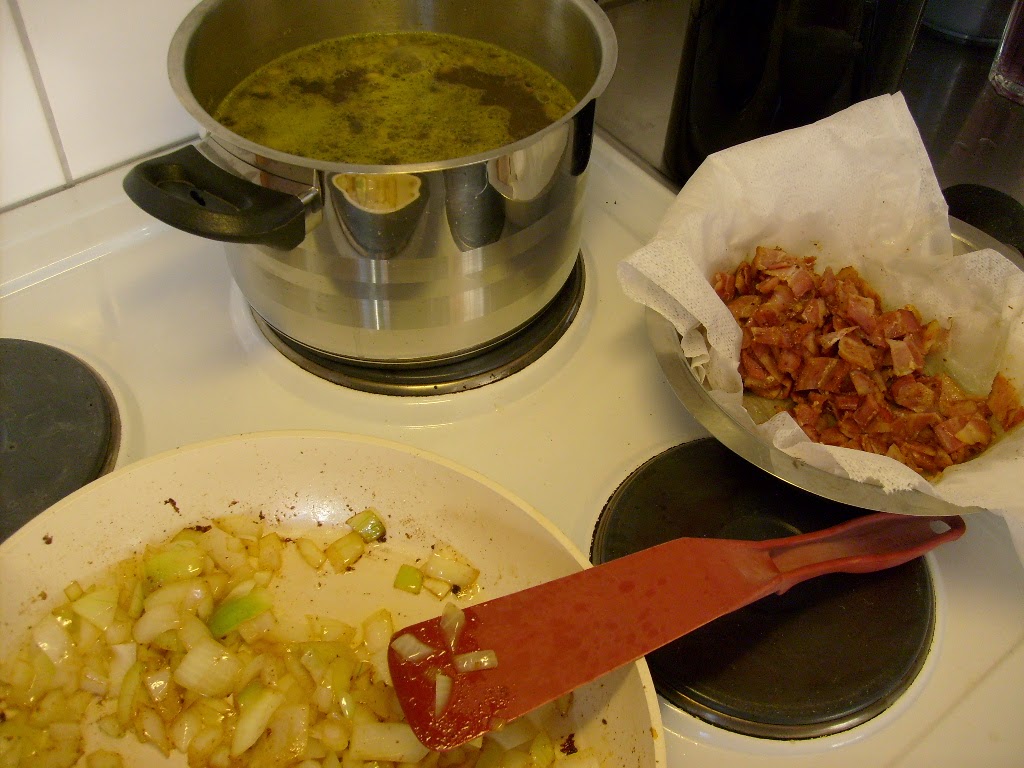
I halved the recipe; the beans come in 900 g bags, which is almost exactly 2 pounds, so I took half that. I let it soak over night, then added 1,5 liters of water, four cubes of vegetable boullion, 2 fried regular size onions, 240 g of fried bacon (they come in 120 g packets), and skipped the ham. I added whole grain white pepper, since it is a slow-cooking thing. No salt, and as it turned out, with the saltiness of the bacon and the boullion, it doesn´t need any.

Dave says to keep this on the stove for 8 hours (!) after soaking, but the reviewers seem to think four was enough. I tried my beans after 3 hours and they were thoroughly cooked, but I wasn´t quite hungry yet then, so I let it sit for another hour, while doing my excercises for the drawing course I am attending. After that, I was both frustrated and hungry!
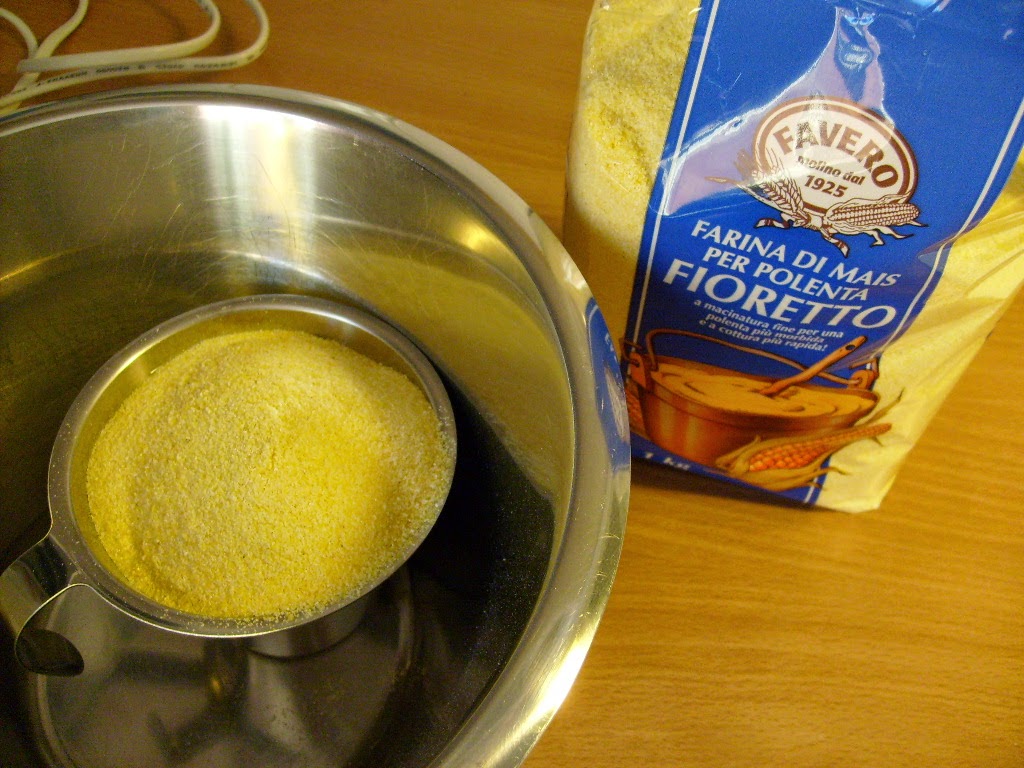


Now, this is important: when Americans speak of corn, they don´t mean korn, which is tempting for a Swede to think. They mean maize (Sw. majs), also called Indian corn, as of corn-on-the-cob (Sw. majskolv). Corn in Britain can mean oats (Sw. havre) or even wheat (Sw. vete). Swedish korn is barley in English, and it´s the stuff they make malt whisky of, while the American bourbon whiskey is at least partly made from corn - I mean maize. Confusing, eh?

The corn (maize) flour I bought comes from Italy and is called farina di mais per polenta. Polenta is a maize porridge, mostly known to Swedes from fancy restaurants where it is left to cool and congeal, cut up, grilled and served with meat. Don´t get the wrong kind, or you will end up with a very boring and sad sponge cake.

I made the cornbread pretty much like I make sponge cake. The trick is to mix the dry ingredients and the wet separately, and then stir just enough to mix it. The mum-in-law taught me to use one of the whisks, it´s a really good trick. It came out very nicely, I think. Perhaps Divers&Sundry will please grade my attempt?

I understand black eye peas are traditional on New Year´s Eve in the southern States, and is considered to bring luck for the new year. Well, I am certainly impressed enough to make this one of my standard recipes and make it for guests as well. We´ll see how it does in the freezer, but I don´t think it matters much if the beans fall apart some.


After having done the dishes, I poured myself a well-deserved G&T and knit some on my scarf while watching Guy Ritchie´s "Sherlock Holmes - A Game of Shadows".


PS. If you are Swedish and reluctant to try American/English (ok, the Brits are officially on the liter scale, but so often prefer "old money") recipes because you can´t get your head around "cups", check out your local ICA or Coop for quarter liter (2,5 dl) measuring cups. They now also come with cup- and half cup measuring lines, as you can see in the picture below. Liters on the right, cups on the left. Thank the good ol´ internet & multiculturalism for that one. DS.


Saturday, September 6, 2014

The International Street Market or The 3-Week Plan: Day 6

Saturday on our food plan is for improvisation and Sundays are for eating with the mum-in-law. This week we included her in our improvisations and brought her food (she declined to come with us this time as she had been on a long walk yesterday and was a bit knackered). Last year was the first time the International Street Market came to Luleå, the weather was smashing and they were a big success. We were a big success to them, buying food for an incredible 8 million SEK! I don´t remember what the husband and I were doing, but we didn´t go then. This year, I was sent by the mum-in-law to get some sausage and cheese on Wednesday, and was bowled over by the diversity and quality of what was on offer.

Today was the last day and the last chance to go for the husband, who became so entusiastic that he declared that next year we shall eat all week at the market. There was certainly enough variation on offer: ragu from France, curry-wurst from Berlin, waffles from Belgium, bigos (hunter´s stew) and pirogi from Poland, fish & chips and curry from England, and more.

Also, next week is the Swedish elections, so there were lots of heated political discussions on the street. The Swedish custom is that every party puts up a valstuga, an election cottage, where people can come and get information and discuss all the current issues. Immigration is a hot topic, and the Sweden Democrats (who aren´t really much for democracy when it comes down to it, having their roots in and being ideologically estabished in the neo-nazi movement) have support from about 10% of the electorate. I hope the abstainers will rise from their sofas this year and stand up for democracy and decency in Swedish politics.

Continental cookies, a grand selection.


Italian chocolate, which I didn´t even know was a Thing.


Turkish delight, of which we had three kinds: almond, rose, and lemon.

The Christian Democratic valstuga. Campaigning that more jobs = more welfare.

Very pretty Brittish teacups.
A sea, nay, an ocean of English fudge (and I bought none, still full up from this summer´s excesses in Scarborough...)!
Centerpartiet (used to be the farmer´s party),
campaigning for a sustainable Sweden.


Not just food on offer, but lovely quality clothing as well.
The strudel-makers were making lots of money!

The Berlin sausage booth had a real fire going.
Local politicial Stefan Tornberg (of Centerpartiet) being photographed with a voter.
Our desserts.
Folkpartiet´s valstuga (the Liberal party), campaigning for
dignified care of the elderly.
Swedes love sitting outdoors, even if it means having warming fire and blankets.

Pirogi, which we had for dinner (among other things).
Bigos, the Polish hunter´s stew, that has sauerkraut in it.
Dutch cheese.
We ended up at home late in the evening in front of a Bond adventure on the television, with whiskey (for me, the husband is a teetotaller) and an assortment of goodies.